Marcel Ducamp Created Art by C Hangeing the Context Nd Meaning Odervydday Objct Sknown as What
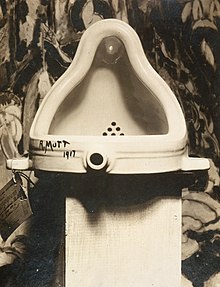
Fountain is a readymade sculpture by Marcel Duchamp in 1917, consisting of a porcelain urinal signed "R. Mutt". In April 1917, an ordinary piece of plumbing chosen by Duchamp was submitted for an exhibition of the Gild of Contained Artists, the inaugural exhibition by the Society to be staged at The K Cardinal Palace in New York. When explaining the purpose of his Readymade sculpture, Duchamp stated they are "everyday objects raised to the nobility of a work of fine art past the artist's act of choice."[2] In Duchamp'southward presentation, the urinal's orientation was altered from its usual positioning.[3] [4] [5] Fountain was not rejected by the committee, since Society rules stated that all works would be accepted from artists who paid the fee, just the work was never placed in the show area.[6] Following that removal, Fountain was photographed at Alfred Stieglitz's studio, and the photograph published in the Dada journal The Blind Man. The original has been lost.
The work is regarded past fine art historians and theorists of the avant-garde equally a major landmark in 20th-century fine art. Sixteen replicas were commissioned from Duchamp in the 1950s and 1960s and made to his approval.[vii] Some have suggested that the original work was by the female artist Elsa von Freytag-Loringhoven[8] [9] who had submitted it to Duchamp as a friend, simply art historians maintain that Duchamp was solely responsible for Fountain's presentation.[three] [10]
Fountain is included in the Marcel Duchamp catalogue raisonné by Arturo Schwarz; The complete works of Marcel Duchamp (number 345).[11]
Origin [edit]

Eljer Co. Highest Quality Two-Fired Vitreous China Catalogue 1918 Bedfordshire No. 700
Marcel Duchamp arrived in the United States less than two years prior to the cosmos of Fountain and had become involved with Francis Picabia, Human Ray, and Beatrice Forest (amongst others) in the creation of an anti-rational, anti-art, proto-Dada cultural movement in New York City.[12] [thirteen] [14]
In early on 1917, rumors spread that Duchamp was working on a Cubist painting titled Tulip Hysteria Co-ordinating, in preparation for the largest exhibition of modernistic art e'er to take place in the United States.[15] When Tulip Hysteria Co-ordinating did not appear at the testify, those who had expected to run across it were disappointed.[sixteen] But the painting probable never existed.[half dozen] [17]

The urinal suspended in Marcel Duchamp's studio at 33 West 67th Street, New York, 1917-18. Ii other readymades by Duchamp are visible in the photograph: In Advance of the Broken Arm (1915), and Hat rack (Porte-lid) (1917). This photo is reproduced at the summit correct of one of the plates from Duchamp's La Boîte-en-valise.
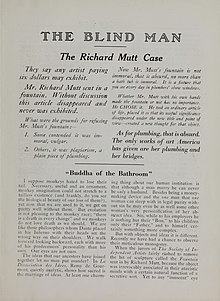

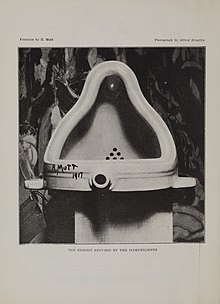
Fountain reproduced in The Blind Man, No. 2, New York, 1917

Jean Crotti, 1915, Portrait of Marcel Duchamp (Sculpture made to measure), mixed media. Exhibited Montross Gallery iv–22 Apr 1916, New York City. Sculpture lost or destroyed[xix]

According to 1 version, the creation of Fountain began when, accompanied past artist Joseph Stella and art collector Walter Arensberg, Duchamp purchased a standard Bedfordshire model urinal from the J. 50. Mott Iron Works, 118 Fifth Avenue. The artist brought the urinal to his studio at 33 Westward 67th Street, reoriented information technology 90 degrees[iii] [4] from its originally intended position of use,[xx] [5] [21] and wrote on it, "R. Mutt 1917".[22] [23] Duchamp elaborated:
Mutt comes from Mott Works, the name of a large sanitary equipment manufacturer. But Mott was too close so I altered information technology to Mutt, after the daily drawing strip "Mutt and Jeff" which appeared at the fourth dimension, and with which anybody was familiar. Thus, from the start, at that place was an coaction of Mutt: a fat piffling funny human, and Jeff: a alpine thin man... I wanted any old name. And I added Richard [French slang for money-bags]. That's not a bad proper noun for a pissotière. Get it? The opposite of poverty. Merely non fifty-fifty that much, simply R. MUTT.[3] [ten]
At the time Duchamp was a lath member of the Society of Independent Artists. Later much debate by the lath members (most of whom did not know Duchamp had submitted it, as he had submitted the piece of work 'nether a pseudonym') about whether the slice was or was non art, Fountain was hidden from view during the show.[24] [25]Duchamp resigned from the Board, and "withdrew" Tulip Hysteria Co-ordinating in protestation.[half-dozen] [26] [27] For this reason the piece of work was "suppressed" (Duchamp'southward expression).[5]
No, not rejected. A work can't be rejected by the Independents. It was simply suppressed. I was on the jury, merely I wasn't consulted, because the officials didn't know that information technology was I who had sent it in; I had written the name "Mutt" on information technology to avert connexion with the personal. The "Fountain" was simply placed behind a division and, for the duration of the exhibition, I didn't know where it was. I couldn't say that I had sent the thing, but I recollect the organizers knew it through gossip. No one dared mention it. I had a falling out with them, and retired from the organization. After the exhibition, we found the "Fountain" once again, behind a partition, and I retrieved it! (Marcel Duchamp, 1971)[28]
The New York Dadaists stirred controversy about Fountain and its existence rejected in the 2d outcome of The Blind Man which included a photo of the slice and a alphabetic character by Alfred Stieglitz, and writings by Louise Norton, Beatrice Wood and Arensberg.[eighteen] An editorial, perchance written by Woods, accompanying the photograph, entitled "The Richard Mutt Case",[29] fabricated a merits that would testify to be important concerning certain works of art that would come afterward it:
Whether Mr Mutt with his own hands made the fountain or not has no importance. He CHOSE it. He took an ordinary commodity of life, placed it so that its useful significance disappeared under the new title and indicate of view – created a new thought for that object.[18]
In defence force of the work being art, the slice continues, "The only works of fine art America has given are her plumbing and her bridges."[18] Duchamp described his intent with the piece was to shift the focus of fine art from physical craft to intellectual interpretation.
In a letter dated 23 April 1917, Stieglitz wrote of the photograph he took of Fountain: "The "Urinal" photograph is really quite a wonder—Everyone who has seen it thinks it beautiful—And it's true—it is. It has an oriental look about information technology—a cantankerous between a Buddha and a Veiled Woman."[three] [30]
In 1918, Mercure de France published an article attributed to Guillaume Apollinaire stating Fountain, originally titled "le Bouddha de la salle de bain" (Buddha of the bathroom), represented a sitting Buddha.[31] The motive invoked for its refusal at the Independents were that the entry was (ane) immoral and vulgar, (2) information technology was plagiarism, a commercial piece of plumbing.[18] R. Mutt responded, co-ordinate to Apollinaire, that the work was not immoral since similar pieces could be seen every day exposed in plumbing and bathroom supply stores.[18] [31] On the second point, R. Mutt pointed out that the fact Fountain was not made by the hand of the creative person was unimportant. The importance was in the choice fabricated by the artist.[31] The creative person chose an object of every-day life, erased its usual significance by giving it a new title, and from this indicate of view, gave a new purely esthetic meaning to the object.[18] [31]
Menno Hubregtse argues that Duchamp may take chosen Fountain as a readymade considering it parodied Robert J. Coady's exaltation of industrial machines as pure forms of American art.[32] Coady, who championed his telephone call for American art in his publication The Soil, printed a scathing review of Jean Crotti'due south Portrait of Marcel Duchamp (Sculpture Made to Measure) in the December 1916 consequence. Hubregtse notes that Duchamp's urinal may have been a clever response to Coady's comparison of Crotti's sculpture with "the absolute expression of a—plumber."[33]
Some have contested that Duchamp created Fountain, simply rather assisted in submitting the piece to the Lodge of Independent Artists for a female friend. In a letter dated 11 Apr 1917 Duchamp wrote to his sister Suzanne: "Une de mes amies sous un pseudonyme masculin, Richard Mutt, avait envoyé une pissotière en porcelaine comme sculpture" ("Ane of my female person friends under a masculine pseudonym, Richard Mutt, sent in a porcelain urinal as a sculpture.")[34] [35] [36] Duchamp never identified his female person friend, but three candidates accept been proposed: an early appearance of Duchamp'south female person alter ego Rrose Sélavy;[3] [10] the Dadaist Elsa von Freytag-Loringhoven;[35] [37] or Louise Norton (a Dada poet and a close friend of Duchamp,[38] subsequently married to the avant-garde French composer Edgard Varèse),[39] who contributed an essay to The Blind Man discussing Fountain,[18] and whose address is partially discernible on the newspaper entry ticket in the Stieglitz photograph.[40] On one hand, the fact that Duchamp wrote 'sent' non 'made', does not signal that someone else created the work.[iii] Furthermore, in that location is no documentary or testimonial bear witness that suggests von Freytag created Fountain.[3]
Shortly later its initial exhibition, Fountain was lost. According to Duchamp biographer Calvin Tomkins, the best approximate is that information technology was thrown out as rubbish by Stieglitz, a mutual fate of Duchamp'due south early on readymades.[41] Still, the myth goes that the original Fountain was in fact not thrown out just returned to Richard Mutt past Duchamp.[34] [35] [36]
The reaction engendered past Fountain connected for weeks following the exhibition submission. An article was published in Boston on 25 April 1917:
A Philadelphian, Richard Mutt, member of the society, and not related to our friend of the "Mutt and Jeff" cartoons, submitted a bathroom fixture every bit a "work of art." The official record of the episode of its removal says: "Richard Mutt threatens to sue the directors considering they removed the bathroom fixture, mounted on a pedestal, which he submitted as a 'work of art.' Some of the directors wanted it to remain, in view of the society's ruling of 'no jury' to determine on the merits of the 2500 paintings and sculptures submitted. Other directors maintained that information technology was indecent at a coming together and the bulk voted it downwards. As a result of this Marcel Duchamp retired from the Lath. Mr. Mutt at present wants more than his dues returned. He wants damages."[42] [43]
Duchamp began making miniature reproductions of Fountain in 1935, first in papier-mâché and then in porcelain,[44] for his multiple editions of a miniature museum 'retrospective' titled Boîte-en-valise or 'box in a suitcase', 1935–66.[45] [46] [47] Duchamp carried many of these miniature works within The Suitcase which were replicas of some of his most prominent work.[48] The first 1:1 reproduction of Fountain was authorized by Duchamp in 1950 for an exhibition in New York; two more individual pieces followed in 1953 and 1963, and so an artist'south multiple was manufactured in an edition of eight in 1964.[49] [l] [51] These editions concluded up in a number of of import public collections; Indiana Academy Art Museum, San Francisco Museum of Modernistic Art, the National Gallery of Canada, Middle Georges Pompidou and Tate Modern. The edition of 8 was manufactured from glazed earthenware painted to resemble the original porcelain, with a signature, reproduced in black paint.[3]
Interpretations [edit]
Of all the artworks in this series of readymades, Fountain is possibly the all-time known because the symbolic meaning of the toilet takes the conceptual claiming posed past the readymades to their near visceral farthermost.[52] Similarly, philosopher Stephen Hicks[53] argued that Duchamp, who was quite familiar with the history of European art, was plain making a provocative statement with Fountain:
- The artist is a not smashing creator—Duchamp went shopping at a plumbing store. The artwork is not a special object—information technology was mass-produced in a factory. The experience of art is not exciting and ennobling—at best information technology is puzzling and generally leaves one with a sense of distaste. But over and to a higher place that, Duchamp did not select just any prepare-made object to brandish. In selecting the urinal, his bulletin was clear: Art is something you piss on.[53]
The impact of Duchamp's Fountain inverse the manner people view art due his focus upon "cognitive art" reverse to merely "retinal art", as this was a means to engage prospective audiences in a thought-provoking way as opposed to satisfying the aesthetic condition quo "turning from classicism to modernity".[54]
Since the photograph taken by Stieglitz is the only image of the original sculpture, in that location are some interpretations of Fountain by looking not only at reproductions but this detail photograph. Tomkins notes:
- "Arensberg had referred to a 'lovely form' and information technology does not accept much stretching of the imagination to meet in the upside-down urinal'southward gently flowing curves the veiled caput of a archetype Renaissance Madonna or a seated Buddha or, maybe more to the point, one of Brâncuși's polished erotic forms."[1] [55]
Expanding upon the erotic interpretation linked to Brancusi's work, Tim Martin has argued in that location were potent sexual connotations with the Fountain, linked to it existence placed horizontally. He goes onto say:
- "In placing the urinal horizontally it appears more than passive, and feminine, while remaining a receptacle designed for the functioning of the male penis."[56]
The meaning (if whatever) and intention of both the piece and the signature "R. Mutt", are difficult to pivot downward precisely. Information technology is not clear whether Duchamp had in listen the High german "Armut" (significant "poverty"), or maybe "Urmutter" (meaning "great mother").[35] The name R. Mutt could also be a play on its commercial origins or on the famous comic strip of the time, Mutt and Jeff (making the urinal peradventure the first piece of work of art based on a comic).[57] Duchamp said the R stood for Richard, French slang for "moneybags", which makes Fountain a kind of scatological golden calf.[23]
Rhonda Roland Shearer in the online journal Tout-Fait (2000) suspects that the Stieglitz photo is a composite of dissimilar photos, while other scholars such as William Camfield have never been able to match the urinal shown in the photo to any urinals found in the catalogues of the time period.[10]
In a 1964 interview with Otto Hahn, Duchamp suggested he purposefully selected a urinal because it was disagreeable. The option of a urinal, according to Duchamp, "sprang from the idea of making an experiment concerned with sense of taste: choose the object which has the least run a risk of being liked. A urinal—very few people recall there is anything wonderful about a urinal."[21] [58]
Rudolf East. Kuenzli states, in Dada and Surrealist Film (1996), after describing how diverse readymades are presented or displayed: "This decontextualization of the object's functional identify draws attention to the cosmos of its artistic meaning by the choice of the setting and positioning ascribed to the object." He goes on to explicate the importance of naming the object (ascribing a title). At least three factors came into play: the choice of object, the title, and how it was modified, if at all, from its 'normal' position or location. By virtue of placing a urinal on a pedestal in an art exhibition, the illusion of an artwork was created.[59]
Duchamp drew an ink copy of the 1917 Stieglitz photo in 1964 for the cover of an exhibition catalogue, Marcel Duchamp: Ready-mades, etc., 1913–1964. The illustration appeared every bit a photographic negative. Later, Duchamp fabricated a positive version, titled Mirrorical Return (Renvoi miroirique; 1964). Dalia Judovitz writes:
Structured as an emblem, the visual and linguistic elements set a punning coaction that helps the states to explore further the mechanisms that Fountain actively stages. On the one hand, there is the mirror-effect of the drawing and the etching, which although they are most identical visually, involve an active switch from one artistic medium to the other. On the other hand, there is the internal mirrorical return of the image itself, since this urinal, like the 1 in 1917, has been rotated ninety degrees. This internal rotation disqualifies the object from its common utilize as a receptacle, and reactivates its poetic potential every bit a fountain; that is, equally a machine for waterworks. The "splash" generated by Fountain is thus tied to its "mirrorical return," similar the faucet in the championship.[five]
During the 1950s and 1960s, as Fountain and other readymades were rediscovered, Duchamp became a cultural icon in the globe of art, exemplified by a "deluge of publications", as Camfield noted, "an unparalleled example of timing in which the burgeoning interest in Duchamp coincided with exhilarating developments in avant-garde art, virtually all of which exhibited links of some sort to Duchamp." His art was transformed from "a minor, abnormal phenomenon in the history of mod art to the virtually dynamic force in contemporary art."[x] [39]
Legacy [edit]
In Dec 2004, Duchamp'southward Fountain was voted the near influential artwork of the 20th century past 500 selected British fine art world professionals. Second identify was afforded to Picasso'south Les Demoiselles d'Avignon (1907) and 3rd to Andy Warhol'south Marilyn Diptych (1962).[60] The Independent noted in a Feb 2008 commodity that with this single work, Duchamp invented conceptual art and "severed forever the traditional link between the artist's labour and the merit of the piece of work".[61]
Jerry Saltz wrote in The Village Phonation in 2006:
Duchamp adamantly asserted that he wanted to "de-deify" the artist. The readymades provide a way effectually inflexible either-or aesthetic propositions. They represent a Copernican shift in art. Fountain is what's called an "acheropoietoi," [sic] an image not shaped by the hands of an artist. Fountain brings u.s. into contact with an original that is nevertheless an original merely that also exists in an altered philosophical and metaphysical land. It is a manifestation of the Kantian sublime: A piece of work of art that transcends a grade but that is too intelligible, an object that strikes downwardly an idea while assuasive it to jump up stronger.[23]
Others accept questioned whether Duchamp'due south Fountain really could plant a work of art. Grayson Perry stated in Playing to The Gallery in 2014: "When he decided that anything could be fine art he got a urinal and brought information technology into an art gallery... I discover it quite arrogant, that idea of simply pointing at something and proverb 'That's art.'"[62]
Interventions [edit]

Several performance artists have attempted to contribute to the slice past urinating in information technology. Southward African born artist Kendell Geers rose to international notoriety in 1993 when, at a show in Venice, he urinated into Fountain.[63] Artist / musician Brian Eno alleged he successfully urinated in Fountain while it was exhibited in the MoMA in 1993. He admitted that it was only a technical triumph because he needed to urinate in a tube in advance and so he could convey the fluid through a gap between the protective glass.[64] Swedish artist Björn Kjelltoft urinated in Fountain at Moderna Museet in Stockholm in 1999.[65]
In spring 2000, Yuan Chai and Jian Jun Eleven, ii functioning artists, who in 1999 had jumped on Tracey Emin's installation-sculpture My Bed in the Turner Prize exhibition at Tate Uk, went to the newly opened Tate Modern and tried to urinate on the Fountain which was on display. However, they were prevented from soiling the sculpture directly by its Perspex case. The Tate, which denied that the duo had succeeded in urinating into the sculpture itself,[66] banned them from the premises stating that they were threatening "works of art and our staff." When asked why they felt they had to add to Duchamp'southward work, Chai said, "The urinal is in that location – it's an invitation. Every bit Duchamp said himself, it's the artist's choice. He chooses what is art. We just added to it."[61]
On January 4, 2006, while on display in the Dada testify in the Pompidou Center in Paris, Fountain was attacked past Pierre Pinoncelli, a 76-twelvemonth-sometime French performance creative person, well-nigh noted for damaging two of the 8 copies of Fountain. The hammer he used during the assault on the artwork caused a slight chip.[67] Pinoncelli, who was arrested, said the attack was a work of performance art that Marcel Duchamp himself would have appreciated.[68] In 1993 Pinoncelli urinated into the piece while it was on display in Nimes, in southern French republic. Both of Pinoncelli's performances derive from neo-Dadaists' and Viennese Actionists' intervention or manoeuvre.[69]
Reinterpretations [edit]

Cribbing artist Sherrie Levine created bronze copies in 1991 and 1996 titled Fountain (Madonna) and Fountain (Buddha) respectively. [70] [71] They are considered to be an "homage to Duchamp's renowned readymade. Past doing and then, Levine is re-evaluating 3D objects inside the realm of appropriation, like the readymades, to mass-produced photographic fine art.[72] Adding to Duchamp's audacious motion, Levine turns his gesture back into an "art object" by elevating its materiality and stop. As a feminist artist, Levine remakes works specifically by male artists who commandeered patriarchal dominance in art history."[73]
John Baldessari created an edition of multicolored ceramic bed pans with the text: "The Artist is a Fountain", in 2002.[74]
In 2003 Saul Melman constructed a massively enlarged version, Johnny on the Spot, for Burning Human being and after burned information technology.[75]
In 2015 Mike Bidlo created a cracked "bronze redo" of Fountain titled Fractured Fountain (Not Duchamp Fountain 1917), which was exhibited at Francis Thousand. Naumann Art in 2016.[76] "Bidlo's version is a lovingly handcrafted porcelain copy that he and then smashed, reconstituted, and cast in bronze."[77]
Exactly 100 years to the day of the opening of the First Exhibition of the Order of Independent Artists, Francis M. Naumann Art opened "Marcel Duchamp Fountain: An Homage" on April 10, 2017.[78] The testify included Urinal Cake past Sophie Matisse, Russian constructivist urinals by Alexander Kosolapov, and a 2015 piece of work by Ai Wei Wei.[79] [80]
Afterword [edit]
From the 1950s, Duchamp'due south influence on American artists had grown exponentially. Life magazine referred to him as "perhaps the world's almost eminent Dadaist", Dada's "spiritual leader", "Dada'due south Daddy" in a lengthy article published 28 April 1952.[81] [82] By the mid-50s his readymades were present in permanent collections of American museums.[82]
In 1961, Duchamp wrote a letter to fellow Dadaist Hans Richter in which he supposedly said:
This Neo-Dada, which they phone call New Realism, Pop Art, Assemblage, etc., is an like shooting fish in a barrel way out, and lives on what Dada did. When I discovered the prepare-mades I sought to discourage aesthetics. In Neo-Dada they have taken my readymades and found aesthetic beauty in them, I threw the canteen rack and the urinal into their faces as a challenge and at present they admire them for their aesthetic beauty.[83] [84]
Richter, nonetheless, years afterwards claimed those words were not by Duchamp. Richter had sent Duchamp this paragraph for comment, writing: "Yous threw the bottle rack and the urinal into their confront…," etc. Duchamp simply wrote: "Ok, ça va très bien" ("Ok, that works very well") in the margins.[82] [85]
Contrary to Richter's quote, Duchamp wrote favorably of Popular art in 1964, though indifferent to the humour or materials of Pop artists:
Pop Fine art is a return to "conceptual" painting, most abandoned, except by the Surrealists, since Courbet, in favor of retinal painting… If you lot take a Campbell soup can and repeat it 50 times, yous are not interested in the retinal image. What interests you lot is the concept that wants to put 50 Campbell soup cans on a canvas.[82] [86]
Art market [edit]
The prices for replicas, editions, or works that accept some ephemeral trace of Duchamp attained a record with the purchase of one of the eight 1964 replicas of Fountain.[87] On 17 Nov 1999, a version of Fountain (endemic by Arturo Schwarz) was sold at Sotheby's, New York, for $ane,762,500 to Dimitris Daskalopoulos, who declared that Fountain represented 'the origin of contemporary art'. The price prepare a world record, at the time, for a work by Marcel Duchamp at public auction.[88] [89] The tape was surpassed in 2009 by his 1921 readymade Belle Haleine, Eau de Voilette, a perfume canteen in its box which sold for $11.iv 1000000.[90]
See as well [edit]
- Plant object
- Fountain Annal
- God (sculpture)
- Art intervention
- Transgressive fine art
- Apolinère Enameled
- Tulip Hysteria Co-ordinating
- America, sculpture by Maurizio Cattelan
References [edit]
- ^ a b Tomkins, Duchamp: A Biography, p. 186.
- ^ Martin, Tim (1999). Essential Surrealists. Bath: Dempsey Parr. p. 42. ISBNi-84084-513-9.
- ^ a b c d e f one thousand h i "Fountain, Marcel Duchamp, 1917, replica, 1964". tate.org.united kingdom. Tate. Retrieved v October 2018.
- ^ a b Gavin Parkinson, The Duchamp Book: Tate Essential Artists Series, Harry N. Abrams, 2008, p. 61, ISBN 1854377663
- ^ a b c d Dalia Judovitz, Unpacking Duchamp: Art in Transit, University of California Press, 1998, pp. 124, 133, ISBN 0520213769
- ^ a b c Cabanne, P., & Duchamp, Chiliad. (1971). Dialogues with Marcel Duchamp Archived 15 Nov 2017 at the Wayback Machine
- ^ "An Overview of the Seventeen Known Versions of Fountain". 2007.
- ^ "Duchamp and the pissoir-taking sexual politics of the art earth".
- ^ Hustvedt, Siri (2019-03-29). "When will the art world recognise the real creative person behind Duchamp's Fountain?". The Guardian. ISSN 0261-3077. Retrieved 2019-03-31 .
- ^ a b c d e Camfield, William A. (1989). Marcel Duchamp, Fountain. Houston, TX: Houston Fine art Press. p. 183. ISBN0939594102. LCCN 87028248.
- ^ Arturo Schwarz, The consummate works of Marcel Duchamp, New York, Delano Greenidge, 2000
- ^ Gaffney, Peter D, "Demiurgic machines: The mechanics of New York Dada. A study of the machine art of Francis Picabia, Marcel Duchamp, and other members of New York Dada during the menstruation, 1912–1922" (2006). Dissertations are available from ProQuest. AAI3211072.
- ^ Hopkins, David, Marcel Duchamp and Max Ernst: The Helpmate Shared, Volume 21 of Clarendon studies in the history of fine art, Clarendon Press, 1998, p. 74, ISBN 0198175132
- ^ Biro, Matthew, The Dada Cyborg: Visions of the New Human in Weimar Berlin, G – Reference, Information and Interdisciplinary Subjects Series, University of Minnesota Press, 2009, p. 27, ISBN 0816636192
- ^ Catalogue of the First Annual Exhibition of the Society of Independent Artists
- ^ Sue Roe, In Montparnasse: The Emergence of Surrealism in Paris, from Duchamp to Dali, Penguin U.k., Jun 21, 2018, ISBN 0241976596
- ^ Dagen, Philippe, "Duchamp piège l'avant-garde", Le Monde, 17 August 2006 (French)
- ^ a b c d east f yard h The Bullheaded Homo, Vol. 2, 1917, p. v.
- ^ Current opinion, Vol. Threescore, No. 6, June 1916, p. 431, Literary digest. New York: Electric current Literature Pub. Co., 1913–1925
- ^ To achieve an orientation resembling the photograph, an additional rotation past 180° about a vertical axis is necessary. The effect of both may be achieved by a rotation of 180° virtually an inclined axis.
- ^ a b Adcock, Craig. Duchamp'south Eroticism: A Mathematical Analysis, Dada/Surrealism 16 (1987): 149–167, Iowa Research Online, ISSN 0084-9537
- ^ Tomkins, Duchamp: A Biography, p. 181.
- ^ a b c Saltz, Jerry (2006-02-21). "Idol Thoughts: The celebrity of Fountain, Marcel Duchamp's footing-breaking 'moneybags piss pot'". The Village Phonation.
- ^ Cabanne, Dialogs with Marcel Duchamp, p. 55
- ^ Levine and Halle, Sherrie and Howard (1992). "Fountain (After Duchamp: 1-6) La Fortune (After Duchamp: one-6) La Fortune (After Homo Ray: 1-half-dozen)". One thousand Street. 1 (42): 81–95. doi:x.2307/25007559. JSTOR 25007559. Retrieved 26 August 2021.
- ^ "Fountain", wrote the committee, "may be a very useful object in its identify, merely its place is non an art exhibition, and it is by no definition, a work of art."
- ^ Unsigned review, "His Art Too Rough for Independents", The New York Herald, fourteen April 1917 (cited in Camfield, 1989, op.cit., 27)
- ^ Cabanne, Pierre, & Duchamp, Marcel, Dialogues With Marcel Duchamp, Hudson, 1971, translated from French by Ron Padgett, Da Capo Printing, archive.org
- ^ Tomkins, Duchamp: A Biography, p. 185.
- ^ Naumann, Francis G., The Recurrent, Haunting Ghost: Essays on the Art, Life and Legacy of Marcel Duchamp, New York, 2012, pp. 70–81
- ^ a b c d Guillaume Apollinaire, Le Cas de Richard Mutt, Mercure de French republic, sixteen June 1918, Gallica, Bibliothèque Nationale de French republic.
- ^ Hubregtse, Menno (2009). "Robert J. Coady'southward The Soil and Marcel Duchamp's Fountain: Taste, Nationalism, Capitalism, and New York Dada". Revue d'art canadienne/Canadian Art Review. 34 (two): 28–42. doi:10.7202/1069487ar. JSTOR 42630803.
- ^ Quoted in Hubregtse, "Robert J. Coady's The Soil and Marcel Duchamp's Fountain," 32
- ^ a b Marcel Duchamp to Suzanne, 11 April 1917. Jean Crotti papers, 1913–1973, bulk 1913–1961. Archives of American Art, Smithsonian Establishment
- ^ a b c d Gammel, Irene (2002). Baroness Elsa: Gender, Dada, and Everyday Modernity. Cambridge: The MIT Printing. pp. 222–227. ISBN0-262-07231-9.
- ^ a b Marcel Duchamp, Affectionately, Marcel: The Selected Correspondence of Marcel Duchamp, ed. Francis M. Naumann and Hector Obalk (Ghent: Ludion Press, 2000), p. 47
- ^ Robert Reiss, "My Baroness: Elsa von Freytag-Loringhoven" in New York Dada, edited by Rudolf E. Kuenzli (New York: Willis Locker & Owens, 1986), pages 81–101.
- ^ Tate. "'Fountain', Marcel Duchamp, 1917, replica 1964". Tate . Retrieved 2020-07-26 .
- ^ a b David Yard. Lubin, Grand Illusions: American Fine art and the First World State of war, Oxford University Press, 2016, ISBN 0190218622
- ^ Francis M. Naumann, New York Dada, 1915–23 (New York: Harry N. Abrams, 1994), p. 239, notation 17.
- ^ Quoted in Gayford, Martin (sixteen February 2008). "The practical joke that launched an artistic revolution". The Daily Telegraph. London. p. 10 at xi. Archived from the original on 2022-01-12.
- ^ Franklin Clarkin, "2 Miles of Funny Pictures," Boston Evening Transcript, 25 April 1917.
- ^ William A. Camfield, Marcel Duchamp's Fountain, Its History and Aesthetics in the Context of 1917 (Role 1), Dada/Surrealism 16 (1987): pp. 64–94.
- ^ "A Museum That is Not". www.e-flux.com . Retrieved 2020-08-14 .
- ^ Duchamp, Marcel. "Boîte-en-valise [The box in a valise]". Item held by National Gallery of Australia . Retrieved 2020-08-14 .
- ^ "MoMA.org | Interactives | Exhibitions | 1999 | Museum equally Muse | Duchamp". world wide web.moma.org . Retrieved 2020-08-fourteen .
- ^ "From or by Marcel Duchamp or Rrose Sélavy". Cleveland Museum of Art. 31 October 2018.
- ^ Martin, Tim (1999). Essential Surrealists. Bathroom: Dempsey Parr. pp. 42–47. ISBN1-84084-513-9.
- ^ "An Overview of the Seventeen Known Versions of Fountain". www.cabinetmagazine.org. Fall 2007. Retrieved 2022-01-02 .
- ^ Essay on Fountain Archived 2004-10-12 at the Wayback Automobile
- ^ Funcke, Bettina (2013). Not Objects then much as Images (PDF). p. 279.
- ^ Encounter Praeger, Dave (2007). Poop Civilisation: How America is Shaped by its Grossest National Product. Los Angeles, Calif.: Feral House. ISBN978-1-932595-21-5.
- ^ a b Hicks, Stephen R. C. (2004). Explaining Postmodernism: Skepticism and Socialism from Rousseau to Foucault. Tempe, AZ: Scholargy Press. p. 196. ISBNi-59247-646-5.
- ^ Rescher, Nicholas (2015). A Journey through Philosophy in 101 Anecdotes. University of Pittsburgh Press. p. 223. ISBN978-0-8229-8044-5.
- ^ Julia Dür, Glasswanderers, If that's art, I'g a Hottentott, Tout-fait, Vol. two, Issue five, April 2003, Succession Marcel Duchamp
- ^ Martin, Tim (1999). Essential Surrealists. Bath: Dempsey Parr. p. 42. ISBN1-84084-513-9.
- ^ Francis M. Naumann, Beth Venn, Making mischief: Dada invades New York, Harry Due north. Abrams, Whitney Museum of American Art, 1997, p. xx.
- ^ Hahn, Otto, Marcel Duchamp, L'Express, Paris, No. 684, 23 July 1964, p. 22. Quoted in Arturo Schwarz, The Complete Works of Marcel Duchamp, New York, Abrams, 1970, p. 466
- ^ Rudolf E. Kuenzli, Dada and Surrealist Motion picture, MIT Printing, 1996, p. 47, ISBN 026261121X
- ^ "Duchamp's urinal tops art survey". BBC News. i December 2004. Retrieved 5 October 2018.
- ^ a b Hensher, Philip (xx Feb 2008). "The loo that shook the world: Duchamp, Man Ray, Picabia". The Independent. London. pp. ii–5.
- ^ Perry, Grayson (2016). Playing to the Gallery. Penguin Books. p. 46. ISBN978-0-141-97961-eight.
- ^ "Kendell Geers- Conceptual Artist". world wide web.onepeople.com . Retrieved 5 October 2018.
- ^ Blacklock, Marking (26 June 2003). "Art attacks". The Daily Telegraph. Archived from the original on 2022-01-12. Retrieved 9 May 2013.
- ^ Årets största konsthändelse Archived 17 May 2011 at the Wayback Machine
- ^ "Tate focus for artistic debate". Press Association (referred to on the website of the Humanities Avant-garde Technology & Information Institute, University of Glasgow). 21 May 2000. Archived from the original on 21 December 2002. Retrieved 17 Feb 2008.
- ^ "Pierre Pinoncelli: This man is not an artist" at infoshop.org Archived 4 December 2014 at the Wayback Machine
- ^ "Man held for hitting urinal work". BBC News. vi January 2006. Retrieved v October 2018.
- ^ Revue Internationale du Droit d'Auteur, Problems 197–198, Association française pour la diffusion du droit d'auteur national et international, 2003, p. thirty.
- ^ "SHERRIE LEVINE: MAYHEM". whitney.org . Retrieved 2020-08-14 .
- ^ "Fountain (Buddha)". Museo Jumex . Retrieved 2020-08-xiv .
- ^ Levine and Halle, Sherrie and Howard (1992). "Fountain (After Duchamp: 1-half dozen) La Fortune (Afterwards Man Ray: 1-6)". Grand Street. 42 (i): 81–95. doi:10.2307/25007559. JSTOR 25007559. Retrieved 28 August 2021.
- ^ "Fountain (Buddha) - Sherrie Levine | The Broad". www.thebroad.org . Retrieved 2020-08-14 .
- ^ "John Baldessari - Repository (Orangish/Blue); and Repository (Red/Green), 2002". Phillips . Retrieved 2020-08-14 .
- ^ Chun, Kimberly (2013-08-15). "Approach of Called-for Man sparks an outbreak of art". SFGate . Retrieved 2020-08-fourteen .
- ^ Greenberger, Alex (2016-02-sixteen). "Mike Bidlo at Francis K. Naumann Fine Art". ARTnews.com . Retrieved 2020-08-fourteen .
- ^ "Mike Bidlo: Not Duchamp Fountain and Bottle Rack | Francis Thousand. Naumann Fine Art | Artsy". www.cocked.net . Retrieved 2020-08-14 .
- ^ "Marcel Duchamp, Fountain: An Homage « ARTEIDOLIA". Retrieved 2020-08-14 .
- ^ ""Fountain: An Homage" at Francis Chiliad. Naumann Fine Art". artnet News. 2017-04-eleven. Retrieved 2020-08-fourteen .
- ^ "Marcel Duchamp FOUNTAIN An Homage | Francis M. Naumann Fine Art | Artsy". world wide web.cocked.cyberspace . Retrieved 2020-08-14 .
- ^ Winthrop Sargeant, Dada's Daddy, A new tribute is paid to Duchamp, pioneer on nonsense and nihilism, Life, 28 April 1952, pp. 100–111
- ^ a b c d Girst, Thomas (April 2003). "(Ab)Using Marcel Duchamp: The concept of the Readymade in postal service-War and contemporary American art". Tout-fait: The Marcel Duchamp Studies Online Journal (5).
- ^ Alan Young, Dada and After: Extremist Modernism and English Literature, Manchester University Press, 1983, p. 202, ISBN 071900943X
- ^ Duchamp, in Hans Richter, Dada: Art and Anti-Fine art, New York, McGraw Hill, 1965: pp. 207–208.
- ^ Hans Richter, Begegnungen von Dada bis Heute, Köln, DuMont: pp. 155ff.
- ^ Rosalind Lawman, New York'south Avant-garde, and How It Got There, cited in Jennifer Gough-Cooper and Jacques Caumont, Ephemerides on and about Marcel Duchamp and Rrose Sélavy, 1887–1968, in Pontus Hulten, ed., Marcel Duchamp, Cambridge, MIT Press, 1993, entry for May 17, 1964.
- ^ Marquis, Marcel Duchamp: The Available Stripped Blank A Biography, p. v.
- ^ Francis Thou. Naumann, The Art Defying the Art Marketplace, Tout-fait: The Marcel Duchamp Studies Online Journal, vol. 2, v, April 2003
- ^ Carter B. Horsley, Contemporary Art & 14 Duchamp Readymades, The City Review, 2002
- ^ Laurie Hurwitz, Saint Laurent Collection Soars at Christie'southward Paris. Duchamp's Belle haleine–Eau de voilette, 1921, a readymade of a perfume canteen in its box, sold for a record $11.5 million (€viii.9 million).
Notes [edit]
- The Bullheaded Man, Vol. two, May 1917, New York City.
- Cabanne, Pierre (1979) [1969]. Dialogs with Marcel Duchamp (in French). [S.l.]: Da Capo Press. ISBN0-306-80303-8.
- Gammel, Irene. Baroness Elsa: Gender, Dada and Everyday Modernity. Cambridge, MA: MIT Press, 2002.
- Hubregtse, Menno (2009). "Robert J. Coady'south The Soil and Marcel Duchamp's Fountain: Taste, Nationalism, Capitalism, and New York Dada". Revue d'fine art canadienne/Canadian Art Review. 34 (two): 28–42. doi:10.7202/1069487ar. JSTOR 42630803.
- Kleiner, Fred Southward. (2006). Gardner's Fine art Through the Ages: The Western Perspective. Belmont, Calif.: Thomson Wadsworth. ISBN0-534-63640-3.
- Marquis, Alice Goldfarb (2002). Marcel Duchamp: The Bachelor Stripped Bare A Biography. Minneapolis: MFA Publications: MFA Publications. ISBN0-87846-644-iv.
- Tomkins, Calvin (1996). Duchamp: A Biography. New York, N.Y.: Henry Holt and Company. ISBN0-8050-5789-seven.
Further reading [edit]
- Betacourt, Michael (2003). "The Richard Mutt case: Looking for Marcel Duchamp's Fountain". Art Scientific discipline Enquiry Laboratory. Archived from the original on 1 March 2006.
- West, Patrick (13 December 2004). "He was only taking the piss: Observations on Duchamp and his urinal". New Statesman.
- Schwarz, Arturo, The Complete Works of Marcel Duchamp, revised and expanded edition, New York 1997, no. 345, pp. 648–50
- Kuenzli, Rudolf Due east., Naumann, Francis Thou., Marcel Duchamp: Creative person of the Century, Outcome 16 of Dada surrealism, MIT Press, 1991, ISBN 0262610728
- Adcock, Craig, Marcel Duchamp's Notes from the Large Drinking glass: An N-Dimensional Assay, Ann Arbor, Michigan: UMI Research Printing, 1983, 29–39, ISBN 0835714543
- Sidney Janis Gallery, Claiming and Defy: Extreme Examples by 20 Century Artists, French and American, The New York 57th Street Periodical, 25 September 1950
External links [edit]
- Fountain, Tout-Fait: Marcel Duchamp Studies Online journal
- Duchamp's Fountain, Smarthistory at Khan Academy
- Duchamp and the Gear up-Mades, Smarthistory at Khan Academy
- Duchamp and the Fountain, November, December, galley 4/9/15
Source: https://en.wikipedia.org/wiki/Fountain_(Duchamp)
0 Response to "Marcel Ducamp Created Art by C Hangeing the Context Nd Meaning Odervydday Objct Sknown as What"
Post a Comment