Art Convention Wherein More Important Charcters Are Much Bigger
-
Jan 14, 2019 at 4:55 pm #5781
Artists of the Byzantine Empire had priorities that differed greatly from Greco-Roman traditions. Realism, for example, was no longer of paramount importance. Discuss the shift in stylistic and thematic conventions establish in Byzantine art and how it relates to the changing social and political climate of Eurasia.
-
March 31, 2019 at x:23 pm #7371
The shift from realism to a style which focused more on content and bulletin demonstrates a shift in what was viewed as societally and politically of import in Eurasia during this time. During this time, several large spiritual systems, such every bit early Christianity, Islam, and Judiasm, became large and meaning forces both socially, culturally, and politically. Art, especially iconography, was used to communicate the importance of spiritual systems and themes rather than the realistic imagery of Greco-Roman times. I recollect this is a fundamental social and political shift in agreement the history.
-
April 2, 2019 at 9:47 pm #7389
Every bit new religions, particularly Christianity, grew in popularity you tin see a shift in how those in positions of social and political power demonstrate this in Byzantine art. For example, a the Church of San Vitale Christ is depicted in what is described as the "imperial majestic" robe and in a panel simply below this Emperor Justinian is too depicted in this same "purple purple". Additionally, they are both flanked by people on both sides and this similarity could emphasize the importance or power of Emperor Justinian while trying to avoid breaking the second commandment.
-
Apr 3, 2019 at vii:19 pm #7403
The art of the Byzantine Empire seemed to devolve (but non in a bad way, only in an aging way). The fashion is like to that of the Egyptians in that there are 2D static characters rather than realistic and 3D ones. There is a decline in statues too, so we see much less posing – such as the contrapasso. Most of the fine art is nowadays in murals or in architecture or a mixture of both. At that place are no depictions of polytheism (like in Jewish and Christian fine art) merely I recall they are inspired by older periods to have a variety of people represented in the fine art, hence the use of Saints, Mary, and The Son.
-
April 4, 2019 at 9:53 pm #7430
Lucas- I was looking around for statues from the Byzantine era online, and it was hard to find them! I wonder why at that place are less statues. They could have made less realistic statues, and I wonder why they didn't!
-
April v, 2019 at 11:22 am #7441
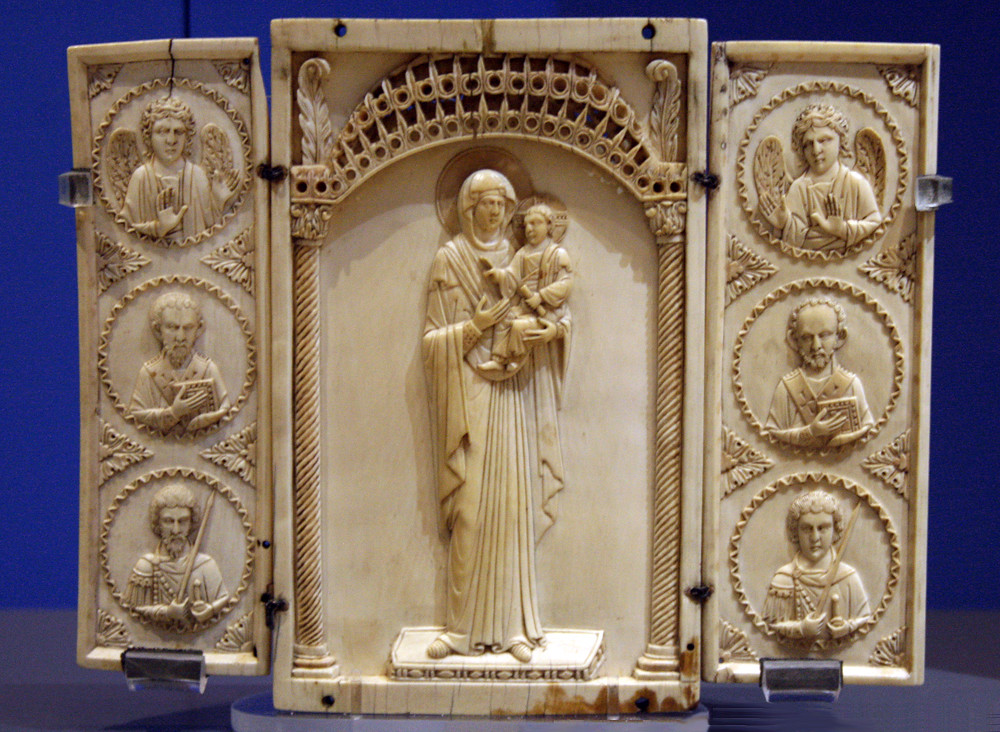
Lucas – I noticed this too! I detect it very interesting that realism is non "as important" anymore during this menses. Out of curiosity, I did Google "Byzantine statues" and I establish mainly carved murals or altar panels, which it seems similar these were more popular during this time anyways. If we look at them, they are very like to the paintings that we accept seen from this period equally well, not at all shut to realism, very stagnant and still.
-
April x, 2019 at 12:25 pm #7591
Hey Lucas – I also noticed the similarity that Byzantine art had to Ancient Egyptian art. I recollect it'due south interesting that the Aboriginal Greek stuff came from this tradition, then sort of went on it'southward ain boot into realism and lifey-ness through the Greek and Roman periods, so kind returned to the old manner in Byzantine art. Looking further ahead the cycle continues with the Renaissance, the onto modern art – sort of a pulsing of these different emphasis. Pretty weird!
-
-
April 3, 2019 at 8:21 pm #7409
Hey elkingkade,
I completely forgot most the 'imperial purple' robes that Emperor Justinian donned in his delineation. The robe Christ is wearing is also the 'imperial purple' that you pointed out, which, as the clarification details, 'harkens back to the Roman Emperors.' I call back it is too important to note that Christ wears the same garb as Emperor Justinian which puts them on similar levels – non necessarily saying they are of the aforementioned significance but that they have the same ability.
-
Apr 3, 2019 at ix:26 pm #7413
Equally Lucas already stated, I too think the Byzantine fine art seemed to devolve somehow. to me information technology seems that fine art is not about the skill of the creative person, or ask focused on little details as nosotros have seen in previous fine art, but is more than geared towards getting the message across. This art is being used as a means to tell a story, the stories in the scriptures, or of the saints or martyrs. I think the culture was less focused on evolving their art, and moe focused as strictly using fine art as a advice device.
-
April 4, 2019 at 12:16 pm #7418
Re: Kaitlyn
You lot make a slap-up betoken about art during this fourth dimension beingness used as a communication device, rather than art for art'south sake. The increased importance placed on religion during this time period certainly turned art into a sort of conversion device/style to express to the general public the power and grandeur of faith in their civilisation.
-
-
Apr iv, 2019 at 12:12 pm #7417
Artistic styles have shifted and evolved often throughout the history of art, and the art of the Byzantine Empire is no exception. Virgin and Kid With Saints And Angels Icon, for example, displays the Virgin Mary'south face and body in a rather realistic way (possibly because she sits in the middle of the piece), but the figures behind her and the "residual of the space is flattened in accordance with Byzantine spacial ambiguity.' Figures during this time period frequently had gold circles painted around their heads to bespeak holiness, and were portrayed with thin, relatively undefined bodies. This shift away from realism makes Byzantine art piece of cake to define as a unique menstruum in history.
Constantine became the showtime Christian Roman Emperor in 312 Advertizement, shortly earlier the beginning of the Byzantine Empire in 330 Advertizing. The emperors during this period likewise held rather expansive goals. Justinian sought to conquer large areas of lost territory. These large changes during the time period likely made religion an important part of life for both the elite and the common classes. -
April iv, 2019 at 7:thirteen pm #7425
Every bit realism died down in this fourth dimension frame we saw that the mode in which the art was created inverse as well. The Byzantine used fine art equally a way to depict their many behavior and tell the story of for example the regal regal robes at the Church of San Vitale Christ. Which after appeared onto God I recollect if I am recalling that correctly. Art was used by these people to tell the stories of higher beings it seems in order to get in easier to understand.
-
April 5, 2019 at 11:26 am #7442
Aalieyah – I completely concord with y'all that there must take been more focus on the message of paintings and art rather than the visual presentation of them. Maybe they strayed away from realism, because it just wasn't the fine art that was important, it was the purpose of communicating the stories of these individuals that was the main signal.
-
-
April iv, 2019 at 9:48 pm #7429
As others accept said, I think the art of the Byzantine era became less realistic considering the point of the fine art was to convey letters, emotions, and stories rather than be a perfect image representing a part of a story people already knew. Christianity was even so relatively young, so I recollect people were using art to tell stories, opposed to the Romans who were just depicting parts of stories that everyone already knew because they were so old.
-
Apr iv, 2019 at 10:12 pm #7431
Early Byzantine fine art changed from the art of the Romans in that information technology is interested in depicting things of mystery similar sky. The Greco-Roman interest was in depth and naturalism. Eye Byzantine menstruation focused on building churches and decorating their interiors. There were also some noteworthy changes in the arts. In that location was the influence of the empire spread into the Slavic earth with the Russian adoption of Orthodox Christianity in the tenth century and Byzantine art was consequently given new life in the Slavic areas.
-
Apr 5, 2019 at 1:45 pm #7450
To Valene
Your case of how the Slavic civilization influenced the Byzantine art was great. Practise you think the departure between Greco-Roman and Byzantine art was due to factors of how they perceived the relationship betwixt God(s) and humanity? The Greeks believed that their gods had human qualities and traits vs how Christianity views God as heavenly and skilful.-
Apr six, 2019 at 11:48 pm #7495
Good question Miranda, I exercise think the Greco-Roman and the Christians viewed "God(southward)" differently. Their ideas of how a God acted or how humanlike they were influenced everything most the stories and scriptures of their Gods.
-
-
-
April 5, 2019 at 12:xviii am #7434
Given my beliefs on organized religion, this may audio a flake crass but it's not meant that way. I feel that the reason that Byzantine art seems to devolve is that in earlier periods, art was used to depict life. Information technology needed a sense of realism to make it believable and relatable. The Gods were shown in to be more than homo-like to help people believe in their existence and their importance in daily life. Byzantine fine art, nonetheless, moved away from realism as the Bible became more important as a religious text. To evidence images described in the Bible in a realistic fashion would devalue their importance in a spiritual and religious context. The young and budding Christianity needed the images to feel surreal and above the average human existence. This was needed to drag the Bible's importance as well as this new organized religion. Another aspect of this is that the early believers needed to set Christianity autonomously from the earlier periods, with their Pagan Gods.
-
Apr v, 2019 at iii:53 pm #7475
Tamara,
This is actually a really great point! Information technology would make sense that putting God and significant characters from the Bible on the aforementioned "level" equally followers would sort of "devalue" them in some manner. I call back you lot are probably right that the slide from realism in religious art occurred because they didn't desire people to see them as human being or mundane in some way. Neat point! -
Apr seven, 2019 at 10:01 am #7496
Re: Tamara
I didn't think your response to organized religion was crass at all and I agree that the realism of past religions tried to bring the humanness of their gods to relate to the people. Christianity was based on a religion where God sent his son to be a man and yet be a role of a holy trinity. That separation needs to be addressed in the art then that the people realize this holy person is someone to respect and put reference to in their holy scriptures. A potent separation from past Pagan gods would have definitely been important too.
-
-
April five, 2019 at 11:02 am #7440
There is definitely a change in the subject matter and the fashion of artists during the Byzantine Era. I am amazed at the focus that was placed on Christian religious Imagery. Gone is the Humanist movement of the Greeks. I did a search for secular Byzantine art and I constitute very fiddling. There were some Islamic images from late in the period and there were some non-religious scenes carved in elephant ivory panels. The commodity I found stated that ivory was not used to depict religious scenes and I saw more realistic looking relief carvings that depicted chariot races and celebrations. Gone were the depictions of peasants and everyday life. Information technology was replaced with a flattened stylized depiction of saints and angels with details that were indicative of their holiness.
-
April five, 2019 at 2:54 pm #7461
Bob, you lot brought upwards a great point that I completely missed this calendar week — there are no depictions of everyday life during the Byzantine Era. Information technology's by and large all religious pieces with no signs on how their life was like outside of their new beliefs. This is a huge divergence from all the other eras we've looked at!
-
April x, 2019 at 11:45 am #7586
Bob Hook-
Kind of a bummer to see the art sway so fiercely from humanism. Secular art was very rare and minimal. It makes me wonder if information technology was destroyed… or if information technology just wasn't created.
-
-
Apr v, 2019 at 12:04 pm #7443
I notice information technology so odd that we take gone from realism and humanism, with such intent focus on what it is to exist man, to a stoic image of humans. In Byzantine fine art, there is mainly focus on individuals from the Bible or religious context. At that place is also quite a scrap of architectural design focus, mainly for the intent of worship. This makes me wonder if the icons that nosotros have looked at as well were for intent of worship. I honestly think the purpose of the art was to inspire people, as they are placing certain individuals on pedestals and highlighting their significance. Old religions became popular during this fourth dimension, and at that place is much focus on virtue. And so, instead of focusing on the visual appeal of art, there is focus on the purpose and message of the art. I think that REBECCA AT THE WELL is an example of this. It is an expensive work of fine art, and it has much significance in telling the story of Rebecca.
Maybe the stylistic shift in art is because focus on humans is shifting from the imperfect and sinful attributes to focusing on attributes that are considered holy and virtuous? I retrieve that this could be one of the reasons to why we see such a desperate shift in art.
-
April 5, 2019 at 12:32 pm #7446
The shift from realism to the sort of abstract art that they did during the Byzantine era generally came out of the intense symbolism that the Christians and Jews wanted to contain into their artwork. Equally they were non meant to worship any icons or graven images, it would be inappropriate if they focused on getting the anatomical detail of the images portrayed rather than the narrative and symbolism. Too, as iconoclasm was going on, they simply did not have the fourth dimension to focus on perfecting anatomical particular, equally they had to practice fine art in secret or in hiding. I think since there was no time for perfection information technology created a fashion unique to Byzantium in which soon became the root of medieval styles.
-
April 5, 2019 at ii:55 pm #7462
Great concept Jessi. I had not considered the fact if they kept the paintings less humanlike than it is easier to deny that they are actual images of the Gods. What I do find interesting that this occurred throughout the timeframe assigned to this era. Almost a thousand years with very petty innovation or change. Information technology seems to me that some denizen would take wanted more than just some other icon to enlighten their lives.
-
Apr 5, 2019 at 2:55 pm #7463
Jessi, the artists having to create everything in undercover would definitely accept a huge impact on how much fourth dimension and effort they can put into each piece, and so information technology makes a lot of sense that they would start to lose focus in details and proportions equally nosotros saw in the Greco-Roman artwork. Imagine how the sculptures nosotros previously saw might look if they had to brand all of those in secret like the Byzantines did. Great post!
-
-
April five, 2019 at 12:35 pm #7447
RE: Miranda Johannson
I agree that they were meant for the intent of worship rather the intent of adoration. I recollect what y'all said hits the nail on the head; that they were instead focusing on the message of the art instead of the visual entreatment. I do favor the greco-roman realism more so, just I understand the reasoning in the artistic shift. -
April 5, 2019 at 12:38 pm #7448
RE: Tamara Toy
I don't think it'south crass! I completely believe this is the reason why we had such an odd shift in the artistic style. They were fighting for recognition and importance, and the focus on symbolism definitely ready them apart from previous cultures we've seen. I also think that maybe they did not have the time or goal to perfect human beefcake. -
April 5, 2019 at two:53 pm #7460
Stylistically, the Byzantine art definitely shifted away from the realistic and structured forms of art that we had seen in the Greco-Roman pieces. Rather than having sculptures, they started to produce more paintings and mosaics that reverted back to being simpler and almost cartoony. For example, the Virgin of Vladimir shows that painted faces no longer have ideal ratios, instead, they beginning to elongate the nose and confront of the adults and don't really accept a youthful await to them. Their artwork also begins to show a larger diversity of different of import figures to their faith also equally an bodily confront for Jesus, which wasn't seen as often in the previous Christian artworks. An interesting thing that I saw is that the Byzantines were struggling through different crises during their fourth dimension period, and at i point split the empire in two with their religion. A lot of their pieces nigh seem to mimic this with their mosaics, which, as we saw, are images made up of smaller fragments of different materials. It could be nothing, but information technology was definitely an interesting little detail I noticed.
-
April five, 2019 at three:06 pm #7465
I feel that during this era, "art" has taken a pace backwards and has go more of a fashion to communicate an thought betwixt a grouping of people rather than a form of expression. In earlier times, rulers used art to drag themselves to a higher level with the gods. I feel that during the Byzantine times, the art was used to spread the message of the church and was less about carrying realism in the artwork. Because the artists had to prove their subject in a pious style, realism was not as important.
-
Apr 5, 2019 at iii:49 pm #7473
The focus of art, and by extension, society, experienced a large shift from previous times. The art of Rome was very much politically driven, with many statues and pieces of art depicting leaders and political structures. This shift came alongside the introduction of several new religions, such every bit the Abrahamic religions. Art went from depicting social and political structures and propaganda to religious structures and propaganda. Decisions made by the public became more driven past their religious beliefs than what their political leaders said. Religious leaders became a large part of gild, and people started listening to their direction instead. These religious pieces of art aren't meant to be realistic, they're meant to show an individualistic way of what these faiths meant to the artist, and their appreciation for such.
-
April v, 2019 at iii:50 pm #7474
Realism showed and depicted what actually happened or the literal advent of the muse. In the case of much of the fine art created from the Byzantine Empire, much was more symbolic than art from the Greco-Roman traditions. For example, the Virgin with Kid and Saints and Angels Icon seems about less realistic than far older art nosotros've encountered, peculiarly the proportions of the infant. The art is not only literally less realistic, merely also figuratively. Much of what is depicted are stories from the Sometime Testament of the Bible, which would have been aboriginal fifty-fifty in this fourth dimension menses, and is most likely inaccurately represented. The political climate at this time was a volatile and oftentimes violent one, perhaps making its citizens cling to a religion full of hope and advantage after expiry for the faithful.
-
April 12, 2019 at 9:54 am #7628
You fabricated a good bespeak near the political climate at the fourth dimension existence conducive to attracting new Christians. Life was dangerous and unsure, people probably died of starvation and affliction a lot. A promise of a good afterlife was probably very bonny. I think at that place are new surges in adoption of Christianity after natural or human disasters, because churches provide humanitarian aid. People become into the church building for blankets and food, see the beautiful art inside and are inspired while their heart is already open from tragedy.
-
-
April 5, 2019 at three:57 pm #7476
I think the less-realistic style certainly does convey emotion ameliorate. I always seem to become defenseless up in the details of art, like the sculptures from the late classical period in Greece for instance. But in these, well-nigh intentionally primitive depictions it seems the message is what polish and not necessarily the art itself, which was about likely the creative person'southward intent.
-
April 5, 2019 at 4:35 pm #7482
Every bit we learned earlier in the semester the Greco-Roman art displayed realism. 'The Ivory Panel with Archangel' from the Byzantine Empire may be inspired by the Greco-Roman robes simply encompasses its own manner through dimension and spacing in the artwork. 'Rebecca at the Well' from the Vienna Genesis made in Syria or Palestine also shares the same characteristics of style as the Romans but differs from the realism perspective of art. The prototype shows multiple scenes being played out in ane. The Byzantine artwork is a continuation of the Greek and Romans just evolved into its own style due to new factors influencing the culture.
-
April 5, 2019 at 5:09 pm #7488
Later exploring the Byzantine Fine art and the Roman Art it seems to me that Byzantine artist were more focus on sending a message to the people rather than focusing on the detail and perfection of their art. They wanted to tell usa the people about their gods and icons example would be that Virgin with the son angles and icons, and almost Christianity and why people should exercise this religion. As for the Roman art was more than focus displaying the perfection and realism of art as a whole for example is shows in the buildings of their temples and other buildings.
-
April 5, 2019 at 6:54 pm #7490
There is a pregnant shift in the way that art is made within the Byzantine Empire compared to what we find in Roman art. I think a big reason for this is the shift away from a humanistic worldview. As the Christian organized religion spread, peoples' values shifted. The goal of the art was no longer to glorify humans. It was instead used to make humans consider God and spiritual things rather than just the natural. Also, in that location was somewhat of a shift in that the people that were depicted were painted in such a way that they were recognizable, but the artists wanted to portray them as spiritual authorities, rather than simply idealized human beings. They also didn't what 'heavenly' things to be seen the same as earthly things. Making more whimsical art that portrayed values and spirituality rather than realism was more of import during the Byzantine Empire.
-
April 5, 2019 at 7:05 pm #7491
RE Csayreswody
Really peachy point! The Romans weren't so concerned virtually telling a story or communicating the values of a faith equally the Byzantine artists were. This really makes a difference in the style they portrayed basically everything! It is pretty incredible how a departure in worldview tin can merely totally shift the mode that people want to document and communicate artistically.
-
April 6, 2019 at 5:51 pm #7493
The different social and religious changes throughout the ages ever tended to modify what kind of fine art was in the world. The semi-new religions that were growing was Christianity which was slowly advancing which of class would reflect in their art. The shift may have come up from the irresolute of how people viewed heaven and world. I think they wanted to create images and paintings to convey the celebrity of heaven and the connection between human and God. In the "Ivory Panel with Archangel' You can see the influence of Roman dress and as well as conveying the power and majesty of the Affections. I think they wanted to move towards conveying the supreme nature of Heaven compared to mankind.
-
April vii, 2019 at 4:26 pm #7500
Looking through the Byzantine art wing, there is a noticeable shift back in time to more than of the Egyptian art era. I say this because realism is non shown in Byzantine art like it is shown in Greco-Roman traditions. There is more of 2D images again such as the hieroglyphics of the Egyptian era. Realism wasn't of import anymore in this era, however the importance for the meaning inside the art became about of import. People were suppose to look at the paradigm and get a better agreement for this era. This became the overall importance in fine art of this time changing the social and political climate of Eurasia.
-
April vii, 2019 at 7:10 pm #7522
I can agree with y'all virtually how they didn't care nearly the perfection of the art merely instead cared more about the importance of the message and religion. Also thank you for pointing out how about art back than was more 2nd never viewed information technology like that or thought to view it similar that
-
-
April 7, 2019 at 4:45 pm #7501
Tamara,
I thought y'all had a lot of smashing examples. I thought all of them were very relevant to testify your points for this discussion. -
Apr 9, 2019 at 4:54 pm #7578
Equally new religions grew, a shift is seen in how those in positions of social and political power demonstrate this in Byzantine art. The new religions that were coming to life were early Christianity, Islam, and Judaism. The spike of religions became a large role in the culture whether it be social, political, or cultural. The fine art that was beingness created during this fourth dimension was then used to communicate how much these spiritual systems were needed and how of import they were compared to the realistic imagery of Greco-Roman times. Byzantine art began to shift back to 2D form instead of 3D grade how art started to shape into over generations. This is a large social and political shift in understanding history. I believe the civilization was less focused on evolving the art they created. This era was more focused on using their fine art to portray stories and communicate. Individuals may not accept tried to evolve art during this era due to strict religions.
-
April 10, 2019 at eleven:50 am #7587
Artists of the Byzantine Empire had priorities that differed greatly from Greco-Roman traditions. Realism, for example, was no longer of paramount importance. Discuss the shift in stylistic and thematic conventions found in Byzantine art and how it relates to the irresolute social and political climate of Eurasia.
The focus of religious imagery is overwhelming. Its kind of a shame to see the humanism fade out nearly completely. This could be due to a neccessity of religion to cope with social and political issues. Humans tend to lean heavy on things out of their control when their situation is out of their command. I appreciate the use of more than abstract impressions of human form that nosotros encounter in some of the tempura paintings.
-
April 10, 2019 at 12:22 pm #7590
I huge difference between the Christian Byzantines and the Ancient Greeks which could account of their disparate fine art styles is the different values coming from their spiritual systems. The Greek Pantheon was very embodied, very full of 'salt and vinegar', didn't shy away from food, sex, violence, etc. In comparing, the Christian mythology is one of temperance, martyrdom, and transcendence. Information technology makes sense that with their animalism for life, the Greeks would depict realism, dynamic expression, and movement in a very visceral and 'realistic' fashion. Christianity however is about transcending this life, so really the realism of this plane of being doesn't matter. Interestingly Byzantine iconography starts to resemble the Ancient Egyptian depictions of deities (especially with the halos) which Greek art originated from. Another reason for the difference in manner goes back to the other discussion mail about the 2d commandment. Given that artwork was more likely to be illegal, the profession of master creative person was less desirable. Iconography probably requires less technical skill that photo realistic rendering, so people concluded up doing what they could do. Without a compelling mythology to motivated them otherwise, simpler depictions of saints and martyrs was the flavor of the day.
Again, sorry for the late mail service 🙁
-
Apr 12, 2019 at 9:45 am #7627
Greco-Roman art focused on realism as the individual human became more valued in their culture. Christianity valued humans equally a flock that faithfully followed Christ as their shepherd. I practice believe in God and Jesus, simply I also believe that some teachings of the bible were meant to proceed the lower class in line.
Early Christians were trying to invent their own art mode that would be separate in means from the Greco-Roman foundation that they had emerged from. The resulting images of humans and Christ ended up abstracted, more than like images in an teaching manual than figures in a photo. I think something that contributed to the abstract nature of Byzantine fine art was that the people illuminating manuscripts were monks locked away underground, not really out looking at the landscapes they were trying to recreate. Some of the abstraction was for the purpose of clear communication though, like in comic books.
Iconoclasm wasn't good for the continued evolution of fine art — it seems to have set artistic ability back a few steps. Artists had to piece of work in secret on books that contained images, and probably were illustrated past novices who had no bang-up masters left to teach them. This is like the pause of Egyptian art by being conquered.
-
April 26, 2019 at 12:15 pm #7946
I noticed a major shift from more realistic sculptures of Greco-Roman period during this time, the content during this menstruum seems to be more important. This can exist attributed to the shift in the church and the amount of influence it had over guild.
The content of this fourth dimension was very church oriented and very restrictive, near a devolution of fine art in a manner. Looking dorsum at previous periods where human proportions and form were at the top of an artists list, it seems like the quality took a back seat to the narrative of the slice.
Source: https://art261.community.uaf.edu/forums/topic/artistic-conventions/
0 Response to "Art Convention Wherein More Important Charcters Are Much Bigger"
Post a Comment